

Why are garden products particularly challenging to transport?
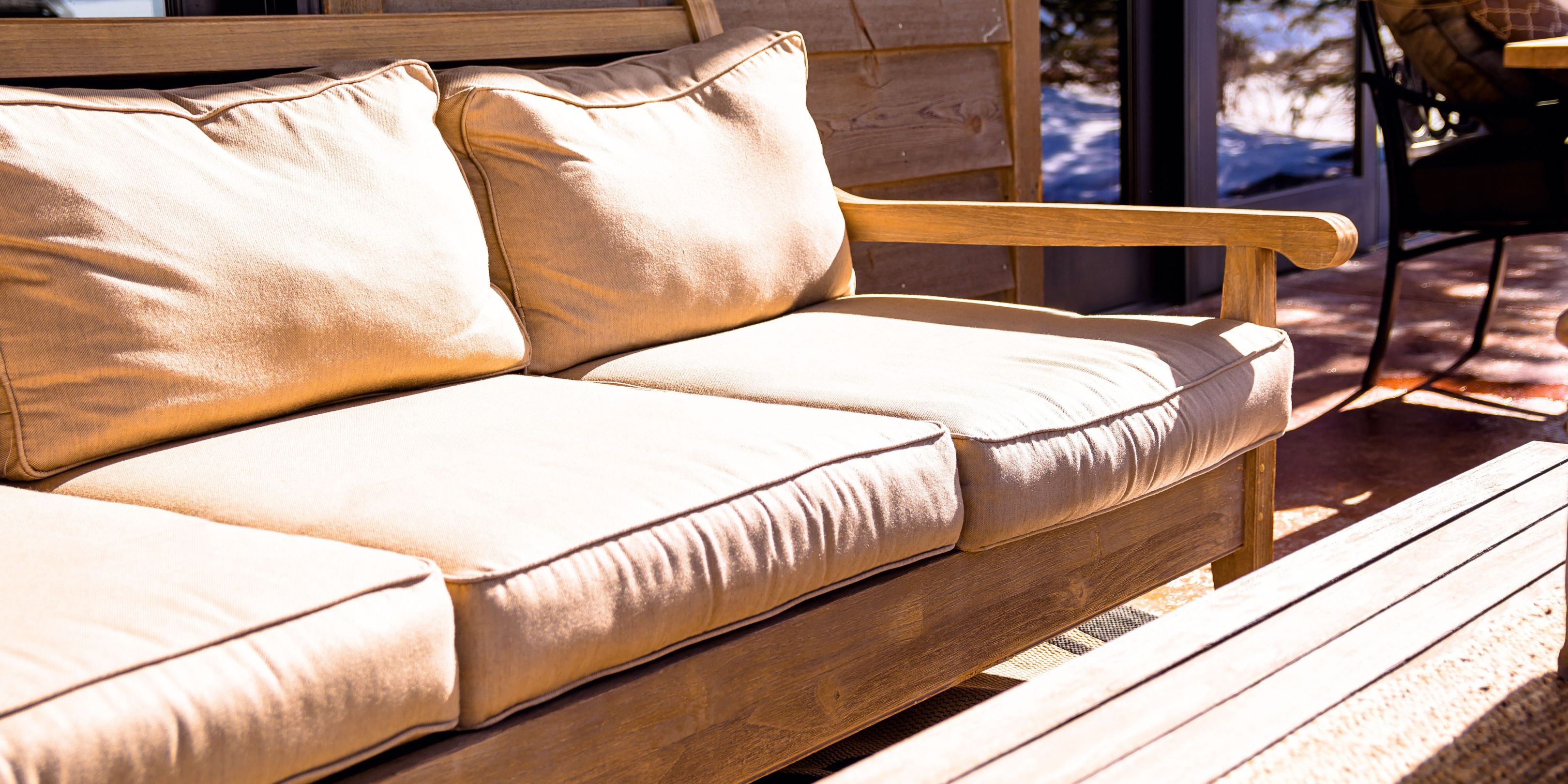
The garden industry encompasses products that differ significantly in terms of weight, shape, surface sensitivity and value. A polyrattan lounge set, an aluminium pergola, a ceramic planter, a greenhouse with tempered glass, and a teak wood sun lounger have very little in common—except that each of them can be damaged during transport in a way that causes the customer to reject the delivery.
In addition, there is the growing importance of e-commerce. Products are no longer shipped exclusively to wholesalers or garden centres. Increasingly, they are delivered directly to end customers, often passing through multiple stages of storage, sorting and handling along the way.
However, several characteristics make this product category particularly demanding from a logistics perspective.
Large dimensions and non-standard shapes
Garden furniture, pergolas and gazebos rarely fit within standard parcel dimensions. Long aluminium profiles, wide tabletops and frames with protruding elements all increase the risk of load movement on a pallet during braking and cornering. Even a shift of just a few centimetres during transport can result in scratches, scuffs or cracks. The larger the product, the more critical it becomes to keep it securely immobilised inside the packaging.
The issue is further compounded by common warehouse practices. Employees often lift products by the first accessible component rather than by parts designed to withstand mechanical stress. Aluminium profiles, tubes and pergola beams are particularly vulnerable in this regard, as the point at which force is applied often determines whether the material will withstand the load or become damaged.
Sensitive surfaces and decorative finishes
Powder-coated aluminium, oil-finished wood, polyrattan in various weave patterns, high-gloss plastics and sandblasted architectural concrete are surfaces that look excellent in a showroom display but can become scuffed, scratched or faded when they come into direct contact with stretch film, damp cardboard or other structural components.
The mechanism is simple: vibrations during transport (even during normal driving on asphalt roads) cause tiny movements between components that are in contact with one another. If there is no cushioning layer between them, after several hundred kilometres signs of abrasion will appear on every contact surface—damage that customers will notice immediately when unpacking the product.
Products that are both fragile and heavy
Ceramic planters, architectural concrete products, garden fountains and decorative sculptures all share the same primary enemy: impact energy.
If this energy is not absorbed by an appropriate cushioning material, the result is often a crack, chip or, more deceptively, a microcrack that is invisible to the naked eye and only becomes apparent after several weeks of use by the end customer.
Seasonality as a catalyst for logistics mistakes
The garden industry generates the highest annual sales volumes between March and June. Peak season means overloaded warehouses, a higher turnover of staff due to temporary employment, carriers operating under tight deadlines and constant pressure to speed up loading processes. It is during this busiest period that packaging mistakes occur most frequently, even though they may be rare throughout the rest of the year. Packaging systems must therefore be designed to perform reliably even when warehouse employees are working under pressure, in a hurry or experiencing fatigue.
The most common types of transport damage in the garden industry
Scratches on powder-coated aluminium
This is statistically the most common cause of claims in the garden furniture sector. Scratches on powder-coated aluminium surfaces found on profiles, pergola tubes, table frames and stands result from three different mechanisms:
-
Metal-to-metal contact without a protective separator.
Two aluminium profiles or steel components are placed directly against one another. Vibrations during transport cause the surfaces to rub against each other, gradually wearing away the coating. After a journey of just 300 kilometres, scratches may already be visible to the naked eye.
-
Metal-to-cardboard contact in humid conditions.
Cardboard absorbs moisture and becomes rough. Dust particles and cardboard fibres act like sandpaper whenever the load shifts during transport. Manufacturers who rely solely on cardboard often discover this issue only after their first export shipments. Sea freight and multi-day road transport create conditions where exposure to moisture is virtually unavoidable.
-
Movement of the product inside a loosely fitted cardboard box.
The product is not properly secured and can move freely during braking. Every braking event on the road may cause the item to shift by several centimetres. Over the course of a journey, hundreds of such movements can result in hundreds of scratches.
Damage to polyrattan
Polyrattan is highly resistant to weather conditions, but it does not tolerate concentrated pressure or prolonged friction particularly well. Inadequate packaging can lead to fibre abrasion, deformation of the weave, and permanent marks caused by tape or stretch film. One especially problematic practice is wrapping polyrattan directly with stretch film, as the plastic can become embedded between the woven strands and leave permanent deformations when removed. This effect is particularly noticeable along the outer edges of backrests and seats, where the weave is most exposed to pressure.
Cracks and microcracks in ceramics
Garden ceramics are primarily vulnerable to impacts rather than gradual pressure. A planter that passes through the entire packaging process without any visible defects may still contain cracks that are undetectable during inspection and only become apparent after several winters or following an impact with other components during installation by the customer. Particularly dangerous are shocks that occur during handling operations: a forklift braking while carrying a pallet of ceramic products, movement on a conveyor belt in a logistics centre, or a drop during parcel sorting.
Damage to wood – discolouration and deformation
Wood is sensitive not only to mechanical damage but also to chemical and environmental factors. Wrapping wooden products in non-breathable materials can cause moisture to condense beneath the packaging, leading to discolouration and even mould growth. This is particularly problematic during sea freight, where temperature and humidity levels can fluctuate significantly.
Scratches on glass components and ceramic tabletops
Damaged corners and edges
If you review claim photos from various industries, a clear pattern quickly emerges. Corners are the parts most frequently damaged. They are usually the first points to come into contact with the ground, other shipments or elements of the transport vehicle.
This applies equally to garden furniture, planters, storage boxes and pergola structures.
Why cardboard alone does not solve the problem?
Cardboard remains the foundation of most transport packaging solutions, and it is difficult to imagine modern logistics without corrugated board. It protects products from dirt and contamination, facilitates storage and makes it possible to create packaging tailored to the dimensions of a specific product.
However, it does not solve every problem. It does not separate surfaces that may rub against one another. It does not protect corners from point impacts. Nor does it prevent heavy products from moving inside the package. That is why manufacturers increasingly treat cardboard as one component of a protective packaging system rather than as the only protective material.
Protective materials – differences and applications
PE foam – the foundation of surface protection
PE foam is a material that combines cushioning properties with chemical neutrality. It does not react with paints, powder coatings, wood oils or plastics. It does not promote condensation, does not absorb water and retains its cushioning properties even at sub-zero temperatures. This makes it a safe solution for prolonged outdoor storage as well as transportation under changing weather conditions.
In the garden products sector, PE foam rolls are commonly used to wrap aluminium profiles, table and chair legs, pergola tubes and structural components. PE foam sheets, on the other hand, are used as separators between tabletops, protective inserts for ceramic products and cushioning layers during palletisation.
Depending on the application, PE foam is available in the form of rolls, sheets, separators, bags or protective profiles.
It is worth remembering that SONG PE foam with reduced density — available from Mac-Graf — makes it possible to achieve comparable cushioning properties while using less plastic. This means lower material costs, lower packaging weight (and therefore lower transport costs) and better parameters in view of future PPWR regulations concerning the plastic content in packaging.
Bubble wrap – surface cushioning and protection
It helps dissipate the energy of minor impacts and protects products with irregular shapes. It is most commonly used as an outer protective layer applied over an inner layer of PE foam, or as a standalone protective material for parcel shipments of products with a low risk of scratching.
For garden products, bubble wrap is particularly useful for protecting glass components, decorative items with complex shapes and products shipped via courier services. The size of the bubbles matters: small bubbles (10 mm) provide better protection for delicate surfaces and conform more effectively to irregular shapes, while large bubbles (30 mm) offer greater cushioning against impacts.
PE foam laminated with bubble wrap – a two-in-one solution
Laminated material combining a layer of PE foam with bubble wrap is designed for applications with higher protection requirements. The PE foam layer (in direct contact with the product) protects against scratches and is chemically neutral to all surface types. The outer bubble wrap layer absorbs impacts. The material is fully water-resistant and maintains its protective properties across varying temperatures.
Laminated PE foam and bubble wrap is commonly used for export shipments (multi-day transport and changing weather conditions), premium products (where even minor surface scratches are considered unacceptable claims) and e-commerce sales, where products pass through multiple handling and sorting points without any control over how they are treated.
PE protective profiles – protecting corners and edges
Some types of damage can be anticipated even before shipment. If it is known that corners or edges are the most vulnerable parts of a product, these areas should be protected accordingly.
Protective profiles help reduce the risk of damage during handling, loading operations and storage.
PE moulded inserts and custom-fit packaging components – precision protection for premium products
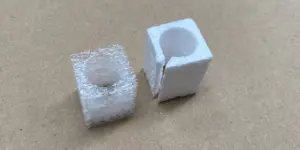
PE moulded inserts are components manufactured from PE foam blocks and tailored to the shape of a specific product. They hold the item securely in a precisely defined position inside the packaging and absorb shocks without transferring stress to sensitive components.
PE moulded inserts make economic sense for higher-value products and for items with irregular shapes that cannot be securely immobilised using standard packaging methods. For manufacturers of premium garden furniture or decorative ceramics, PE moulded inserts are an investment that can pay for itself with the very first avoided claim.
Stretch film – bundling and load stabilisation
Stretch film serves a consolidating function: it keeps set components together, stabilises pallets and limits load movement during transport. However, it is not a protective material against scratches and should not come into direct contact with painted surfaces, technorattan or wood. It is best applied only after a layer of PE foam or laminated protective material has been used.
How to package garden furniture to avoid costly returns and claims?
Garden furniture belongs to a category of products that combine several different materials within a single structure. Aluminium, steel, technorattan, glass, wood and upholstered cushions all respond differently to the conditions encountered during transport. This is precisely why universal packaging solutions rarely perform well in practice.
Garden tables with glass or ceramic tabletops
- Glass or ceramic tabletop: wrap with a PE foam sheet or place in a PE foam bag. Do not apply stretch film directly to glass or ceramic surfaces.
- Corners of the metal frame: use PE protective profiles.
- Frame legs and crossbars: protect with PE tubes or PE foam rolls wrapped around the components.
- Screws, nuts and assembly hardware: pack separately in a bubble wrap pouch with an adhesive strip. Loose metal parts are the fastest way to scratch virtually any surface.
- Place the product in a five-layer corrugated cardboard box with a PE foam sheet used as the bottom cushioning layer.
- Fill the space between the product and the carton walls with large-bubble Fill&Wrap bubble wrap to prevent movement during transport.
For wooden tables, protection against moisture is the top priority. It is best to allow ventilation or use perforated polyethylene foam, as condensation trapped beneath the protective material can damage the wood during prolonged storage or sea transport.
Garden chairs and armchairs
Garden chairs are typically transported in stacks of several units on a pallet. This arrangement increases the risk of damage because the weight of the upper chairs is transferred to the seats and backrests of the lower ones, especially during braking.
For products made of polyrattan or aluminium, it is important to separate individual items from one another. This prevents the weight of the stacked chairs from causing surface damage or deformation of the structure.
- Place a PE foam separator between each pair of chairs in the stack.
- Protect legs and crossbars with PE foam tubes, PE foam bags or PE foam rolls wrapped around the components.
- Wrap the entire stack with stretch film only after applying a PE foam sheet as the outer protective layer.
- Chairs can also be packed directly into custom-sized PE foam bags.
Lounge furniture sets
- Upholstery and cushions: pack separately in sealed PE foam bags or bubble wrap bags (preferably 3-layer bubble wrap to prevent bubble marks on the fabric). Wet cushions inside a cardboard box often result in damaged upholstery.
- Aluminium or steel frames: protect each component with PE foam rolls and use PE protective profiles on all corners.
- Set components on the pallet: use PE foam blocks as spacers to ensure that no parts come into direct contact with one another.
- Complete set on the pallet: apply stretch film as the outer layer only after placing PE foam sheets on all surfaces that may come into contact with the film.
Sun loungers and garden swings
A sun lounger has many protruding components, such as armrests, adjustment mechanisms and movable supports. Standard packaging using stretch film alone, without PE protective profiles, often causes these elements to damage neighbouring parts whenever the load shifts during transport.
- Folded sun lounger: wrap the entire length with PE foam rolls, paying particular attention to adjustment mechanisms, pivot points and moving parts.
- Stacked transport: place a PE foam sheet between each sun lounger.
- Garden swings: pack chains, ropes and screws separately in bubble wrap bags.
How to protect ceramics, architectural concrete and planters during transport?
Garden ceramics – the principle of cushioning proportional to weight
- Small planters (up to 20 cm, weighing less than 3 kg): wrap with PE foam and place in a cardboard box with a thick PE foam base and side cushioning. The planter must not come into contact with the carton walls.
- Medium-sized planters (20–40 cm, weighing 3–10 kg): use PE foam with additional reinforced protection on corners and edges. When transporting multiple units together, place PE foam separators between them.
- Large planters (over 40 cm, weighing more than 10 kg): use custom PE moulded inserts inside a five-layer corrugated cardboard box. Never pack large planters directly inside one another without PE separators, as the weight of the upper planter creates concentrated stress points with every impact or vibration.
Architectural concrete – the challenges of textured surfaces
The sandblasted or textured surface of architectural concrete can be scratched by even minimal friction against stretch film or damp cardboard. Any direct contact with stretch film may leave permanent marks which, unfortunately, are particularly visible on darker textured finishes.
- First layer: PE foam covering the entire surface.
- PE protective profiles on all corners.
- Five-layer corrugated cardboard as the outer mechanical protection.
- For products weighing more than 30 kg: use a sturdy pallet secured with strapping tape.
High-gloss plastics and fibreglass
Fibreglass planters and high-gloss plastic planters (often premium products with painted finishes) are highly susceptible to scratching even under minimal pressure. Using a PE foam and bubble wrap laminate as the first protective layer is a safe and effective solution.
Cheap packaging does not always mean lower costs – case study
For many years, one furniture manufacturer protected its products using cardboard inserts. At first glance, the solution seemed economical. The material was readily available and relatively inexpensive.
The problems became apparent later.
The furniture was distributed to retail chains across Poland, and transport-related damage became increasingly common. Product claims began generating costs that far exceeded the savings achieved by choosing a cheaper protective packaging material.
After analysing the packaging process, the customer decided to replace part of the existing protection system with solutions based on polyethylene foam. The change involved more than simply substituting one material for another. The new protective components could be reused multiple times during packing, unpacking, product presentation and return transport. In addition, the risk of damage to surfaces and corners was significantly reduced.
The most important outcome, however, was the business impact.
The reduction in product claims led to lower costs associated with repairs, replacements and claim handling. This is a good example showing that packaging costs should be evaluated from a broader perspective rather than solely on the basis of the purchase price of the packaging material.
How much does a transport damage claim really cost? The expense companies often overlook
Companies usually analyse the cost of packaging materials. Much less often do they calculate the total cost of a transport damage claim. A transport claim is not limited to the value of the product or component that must be replaced. Additional costs include return shipping from the customer, reshipping of the replacement product, handling of the claim itself (employee time, documentation and communication with the carrier), lost margin on the order and the risk of receiving negative reviews on sales platforms or from purchasing managers at retail chains.
In e-commerce, there is an additional factor to consider: customers judge a brand not only by the quality of the product itself, but also by the condition in which it arrives. Damage incurred during transport — even when the manufacturer is not at fault — is perceived by the end customer as a problem caused by the seller and often results in a claim against the brand.
Most common mistakes when packaging garden products
→ Mistake 1: Applying stretch film directly to painted surfaces or polyrattan.
Stretch film is a load-stabilising material, not a protective one. Direct contact between plastic and polyrattan or painted surfaces can lead to deformation, discolouration and scratches.→ Mistake 2: Using cardboard as the only form of surface protection.
Cardboard protects against dirt and major impacts, but it does not separate components, does not cushion friction and loses its strength when exposed to moisture.
→ Mistake 3: Using PE foam that is too thin.
PE foam with a thickness of 2–3 mm applied to aluminium profiles does not absorb enough energy to prevent scratches and serves mainly a cosmetic purpose. The minimum effective thickness for powder-coated profiles is 5–8 mm.
→ Mistake 4: Failing to immobilise the product inside the packaging.
A product that simply “sits” inside a cardboard box without being secured to its shape will shift with every impact and braking manoeuvre during transport.
→ Mistake 5: Packing ceramic planters inside one another without separators.
At first glance, this may seem like an efficient solution, but with every impact or vibration, the weight of the upper planter is transferred directly to the edge of the one below, creating concentrated pressure points.
→ Mistake 6: Using cardboard corner protectors for export shipments.
Cardboard loses its strength in humid shipping containers and during outdoor storage. PE protective profiles retain their protective properties in all weather conditions.
→ Mistake 7: Wrapping wood without allowing ventilation.
Condensation trapped beneath a vapour-tight film can lead to mould growth, discolouration and deterioration of the wood surface. Wood needs to breathe, even when packaged.
→ Mistake 8: Not using PE foam separators between stacked chairs.
When chairs are stacked without PE foam separators, their seats and backrests can damage one another whenever pressure shifts during transport or storage.
Optimising packaging costs
Optimising packaging costs is not simply about reducing the price of materials. It is about finding solutions that provide maximum product protection at an acceptable cost while avoiding unnecessary packaging weight, which directly affects transport expenses.
- Replace standard PE foam with low-density SONG foam. With comparable cushioning performance, SONG foam weighs less and contains less plastic, resulting in lower material costs, reduced transport costs and better compliance with future PPWR requirements.
- Standardise packaging dimensions. If a company uses dozens of different carton sizes, there is often room to reduce the number of formats. Fewer packaging variants mean stronger negotiating power with carton suppliers and fewer packaging selection errors.
- Use custom-cut PE foam and film. PE foam cut to the exact dimensions of a product may be more expensive per linear metre, but it eliminates waste and speeds up the packing process, as employees do not need to make any adjustments.
- Create a packaging checklist at each workstation. Clear instructions (ideally supported by illustrations) showing which materials to use and in what order for a specific product help eliminate mistakes caused by time pressure and staff turnover.
- Regularly review claim rates by product. If a particular product generates a disproportionate number of claims, the packaging system requires improvement — not the freight forwarder.
Answers to frequently asked questions
Is PE foam safe for powder-coated surfaces and painted finishes?
How should lounge furniture sets be packaged to ensure they arrive without scratches?
Key principles include: using PE foam or a PE foam and bubble wrap laminate as the first protective layer on every aluminium or steel component; never applying stretch film directly to polyrattan; packing cushions and upholstery separately in sealed plastic bags; and separating all components on the pallet with PE foam blocks. No decorative surfaces should come into direct contact with one another.
Does SONG PE foam provide the same level of protection as standard PE foam?
SONG foam, with its reduced density, maintains cushioning properties comparable to those of standard PE foam thanks to its optimised cellular structure while using less plastic material. This results in lower material costs, reduced packaging weight and improved compliance with PPWR regulations. For applications where packaging weight directly affects transport costs, such as export shipments and courier deliveries, SONG foam offers a clear economic advantage.
Summary
The garden products industry faces increasingly demanding logistics challenges: more e-commerce, more exports, greater warehouse automation and growing customer sensitivity to the condition of products and packaging upon delivery. Packaging systems that were sufficient five years ago now generate claims whose costs are often many times higher than the investment required to upgrade the packaging process.
The good news is that most transport-related issues in this industry have well-established and proven solutions. PE polyethylene foam protects surfaces without the risk of chemical reactions. PE protective profiles eliminate damage to corners and edges. PE moulded inserts secure irregularly shaped products in place and reduce claims resulting from courier shipments.
The key is not to use the largest possible amount of protective materials, but to select materials that match the specific damage mechanisms, distribution channel and product value. A garden furniture manufacturer has different requirements from a wholesaler of ceramic planters supplying retail chains, and the packaging system should reflect those differences.
Schedule a consultation with our advisor
We can help you optimise your packaging process
Would you like to find out whether your packaging process can be optimised by changing packaging materials or implementing more suitable packaging solutions?
Leave your contact details and one of our advisors will get in touch to discuss your needs and potential cooperation opportunities.
“In many cases, shipping volumes are so high that the potential savings achieved at this stage of the process can amount to substantial sums that can be reinvested in business growth.”

Specializing in the sales of PE foam and bubble wrap, he effectively addresses the needs of clients in the packaging industry. With years of experience, deep market knowledge, and strong negotiation skills, he creates tailored offers and builds long-term business relationships. Outside of work, he’s passionate about basketball — a sport that has taught him the value of teamwork and consistency in achieving goals.
LinkedIn