


Call us
+48 603 234 399
LIGHTING INDUSTRY
Packaging lamps, spotlights, light bulbs, LED lights and other products from the lighting industry
Lighting products are among the more demanding items in logistics processes due to their heterogeneous construction. They combine fragile glass, delicate painted or coated surfaces, precise electronic components, and heavy structural elements such as aluminum castings or steel poles.
In short, the key characteristics of lighting products include:
- Extreme fragility – glass, crystals, and lampshades leave no room for error in logistics.
- Surface sensitivity – modern lighting fixtures are often powder-coated, anodized, or chrome-plated. Even the slightest scratch can disqualify the product for premium customers.
- Irregular shapes – lighting fixtures often have off-center weight distribution and protruding elements that are prone to bending.
- Claims costs – in this sector, the cost of returns and reshipping often exceeds the product margin.
Unfortunately, throughout the supply chain, lighting products are exposed to a range of harmful factors. During road transport, high-frequency vibrations are predominant, which can lead to material fatigue within LED components or loosening of soldered connections. In air transport, changes in pressure and temperature become critical.
| Type of Hazard | Impact Mechanism | Impact on the Product |
|---|---|---|
| Shocks | Sudden impacts during handling or road accidents. | Broken lampshades, cracked housings, damage to control units. |
| Vibrations | Continuous vibrations generated by road surfaces and vehicle engines. | Loosening of screws, damage to delicate filaments in specialized bulbs. |
| Compression | Pressure caused by stacking multiple layers of packaging on a pallet. | Deformation of lampshades, crushing of individual cartons. |
| Moisture and Corrosion | Changes in air humidity and condensation inside packaging films. | Corrosion of metal parts, short circuits in electronic modules. |
| ESD | Build-up of electrostatic charges due to friction between packaging materials. | Invisible semiconductor damage, reduced lifespan of LED components. |
All of this means that the packaging process adopted within a company should be based on an analysis of the root causes of claims and returns, as well as on testing. In many cases, it needs to be tailored to different product types, especially when they vary significantly in terms of weight, fragility, shape, and other characteristics.

Key packaging materials used in the lighting industry
The selection of appropriate protective materials should be preceded by an analysis of the product’s weight, shape, and value. In the lighting industry, two types of polymer materials dominate—polyethylene foam (PE) and bubble wrap—supplemented by modern paper-based solutions such as honeycomb paper, as well as eco-friendly void fillers like Skropak.
Polyethylene foam (PE)
Polyethylene foam (PE) provides better moisture resistance than bubble wrap, which is particularly important when storing goods in unheated warehouses or during sea transport.
It is worth testing different forms of PE foam, as this can significantly speed up the process:
- Sheets and rolls
Used as interlayers between lighting components, preventing them from hitting each other inside the carton.
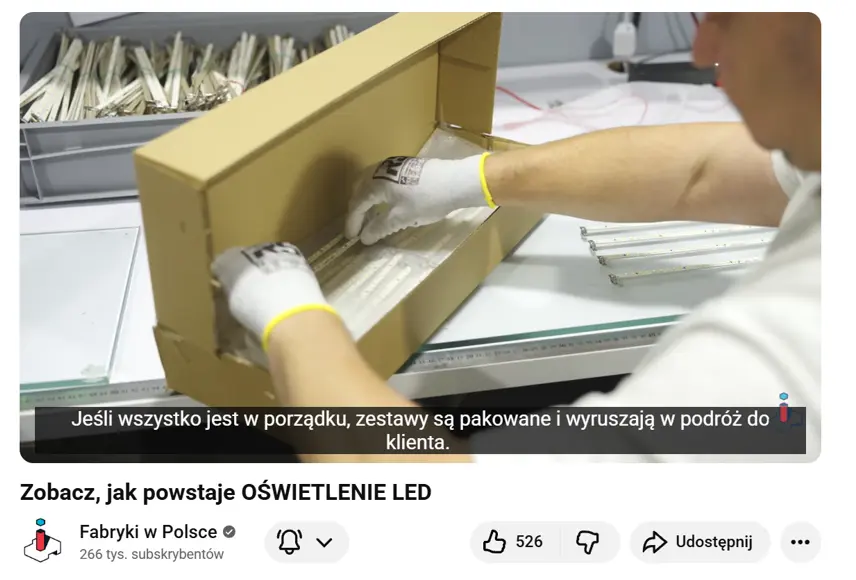
Practical example: placing PE foam sheets between finished LED units packed into cartons.
- PE foam bags
Ideal for packing small mounting components, ceiling panels, or LED modules, ensuring fast packing and consistent protection. They standardize the process and make material consumption easier to predict over time.
- PE foam profiles
Precisely fitted elements that protect the corners of heavy lighting fixtures from deformation in case of package drops.
- PE foam inserts
Specific application example: PE foam inserts used to secure a finished lighting fixture inside a carton. Polystyrene inserts can also be used for this purpose, but many companies prefer PE foam because:
- it does not crumble,
- its components do not scatter around the warehouse,
- it is easier to insert into and remove from packaging (thanks to its flexibility).
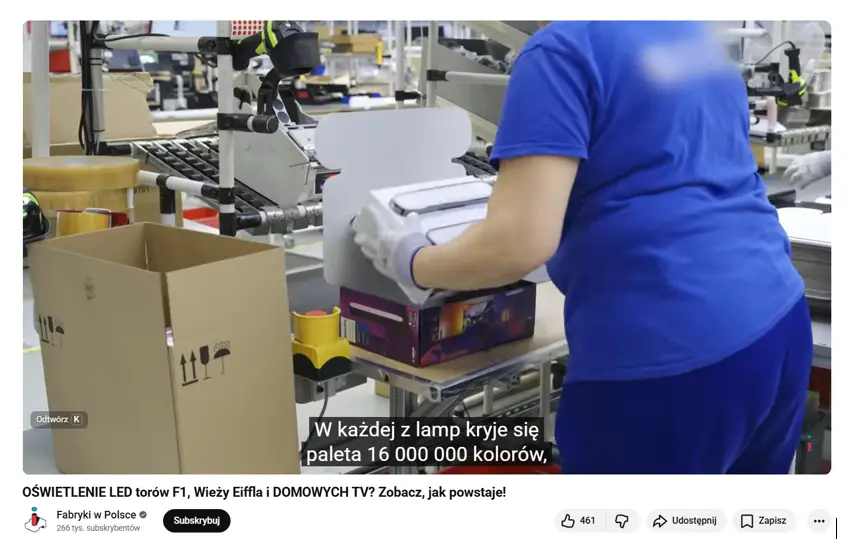
Bubble wrap (small and large bubbles)
Bubble wrap, thanks to its air-filled bubbles, protects products from impacts, absorbs shocks, and helps prevent surface damage.
- Anti-static film (ESD)
Pink anti-static bubble wrap is a standard solution for packaging modern LED fixtures. It prevents electrostatic discharge that could permanently damage control electronics, even if the device shows no visible defects after unpacking.
- Fill&Wrap large bubble wrap
It features bubbles with a diameter of approx. 3 cm. Thanks to the higher air volume, a single layer of film fills significantly more void space than standard bubble wrap, resulting in material savings and reduced package weight.
Specific application example: protecting automotive headlights with FILL&WRAP bubble wrap.
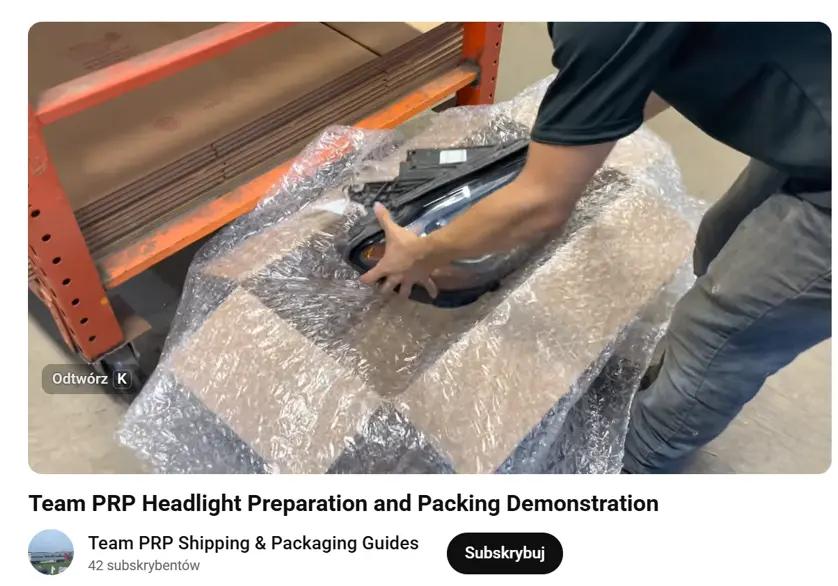
In the above example, it would be advisable to add a cushioning layer at the bottom of the carton. While filling the box from the top protects the headlight from above, impacts from below may make a single wrap insufficient to ensure effective protection.
- Laminates
Połączenie folii bąbelkowej z pianką PE czy tekturą tworzy materiał o zwiększonej odporności na przebicie, idealny do pakowania ciężkich elementów o ostrych krawędziach, takich jak metalowe statywy lamp podłogowych.
Bubble wrap is also available in various formats, helping to streamline the packaging process. It can be ordered as:
- bags (with or without adhesive strip);
- perforated rolls (allowing easy tearing of individual sections);
- tubing (enabling protection of products of varying lengths – ideal for long lighting fixtures);
- half-tubing (which increases the width of the material due to a single-side seal).
Honeycomb paper
This material is 100% biodegradable, aligning with sustainability trends and helping to build a positive, environmentally responsible brand image. It is a good choice for wrapping products (provided they do not have delicate surfaces prone to scratching). However, it is less effective for filling voids in larger packages—here, bubble wrap remains a more cost-efficient solution.
Inflatable air cushions
Thanks to the high air content in each cushion, they effectively fill void spaces inside the package. However, despite being cost-effective in many cases, air cushions are not always the best choice.
Experts do not recommend using them when:
- the product has irregular shapes and requires precise wrapping – air cushions do not provide surface protection;
- the void spaces in the package are small – inserting cushions may be difficult and can lead to product damage or overexpansion of the carton;
- you want to minimize the number of packaging materials used and rely on a single material for both wrapping and void filling (in such cases, FILL&WRAP bubble wrap is a better solution, as it can be used both for wrapping larger product parts and filling empty spaces).
| Material | Application in Lighting | Key Benefit |
|---|---|---|
| Standard bubble wrap and FILL&WRAP | Wrapping glass shades and lampshades. | Shock absorption for point impacts. A key advantage in the lighting industry is that it does not scratch delicate surfaces, which is essential when packaging powder-coated, chrome-plated, or polished brass fixtures. |
| PE foam (Polyethylene) | Interlayers between metal components, wrapping LED profiles. | Scratch protection (non-abrasive to coatings) and stabilization. |
| Foam profiles (U, L) | Protecting edges of large lighting panels or glass sheets. | Corner protection against chipping. |
| Honeycomb paper | Surface protection and protection against light shocks. | Eco-friendly and aesthetically appealing solution. |
| Air cushions | Filling void spaces. | Cost-effective compared to other void fillers. |
Best practices in packaging for the lighting industry
The packaging process in the lighting industry must be precise and repeatable. An analysis of best practices highlights several critical stages, the proper implementation of which significantly reduces the number of claims.
Disassembly and protection of each component
The number one rule in lighting logistics is to disassemble the product as much as possible. Shipping a fully assembled fixture is a common mistake that often leads to damage to arms, shades, and lampshades. Each component—such as glass shades, bulbs (always removed from the fixture!), legs, or decorative elements—should be wrapped separately in multiple layers of bubble wrap or PE foam.
Next steps in the packaging process:
- Cable protection – cables should be coiled and secured with tape or Velcro straps. Metal plugs should be wrapped in a piece of foam to prevent scratching the lamp housing during transport.
- Bulbs should be packed separately, as they require immobilization and protection against impact from other components inside the package.
- Box-in-box technique – for particularly fragile and high-value items, such as crystal chandeliers, double boxing is recommended. The inner carton containing the product is placed inside a larger outer carton, and the space between them (minimum 5 cm) is filled with cushioning materials (e.g. air cushions or bubble wrap).
- Elimination of contact points – each component of the lighting fixture (frame, shade, ceiling canopy) should be separated from one another. If metal comes into contact with glass during transport, a claim is almost guaranteed.
- Components with delicate surfaces should be protected with PE foam, which prevents scratches (cardboard and paper can generate dust, and fine particles may damage surfaces such as painted finishes).
- Immobilization – the product must not move inside the package. Any void space should be filled with large-bubble FILL&WRAP film, paper, polystyrene loose fill (Skropak), or air cushions.
Packaging of specific types of lighting
Packaging individual lamps
It is recommended to place them in an upright position inside a high-strength carton, completely filled with loose-fill materials (e.g. Skropak), which effectively conform to complex shapes and prevent movement or vibration. In contrast, lampshades—due to their susceptibility to crushing—should be nested one inside another, provided they are separated with layers of soft packing paper.
Shipping premium designer lighting fixtures
High-value products can be packed using custom PE foam inserts that immobilize the product—damping vibrations and protecting it from shocks and impacts.
Protecting long lighting fixtures
Long lighting fixtures are challenging to pack, but the process can be streamlined by placing them into pre-made bubble wrap half-sleeves (which can be cut to the required length) instead of wrapping them from a roll. This helps standardize the process in terms of time and material consumption. Telescopic cartons can also be highly useful in this case.
Packaging automotive headlights
Due to their relatively standardized dimensions, automotive headlights are often packed in bubble wrap bags or PE foam bags. In such cases, the headlight can simply be placed inside a pre-made bag and sealed. The carton should then be filled with large-bubble wrap to absorb potential shocks and impacts.
Lighting packaging examples and optimization ideas
Packaging methods vary widely between companies and depend on factors such as product assortment, weight, value, transport mode, and many other variables that should be assessed individually for each business. However, let’s take a look at some example packaging approaches used in the lighting industry and explore what could be improved:
Example 1 – packaging a lighting fixture
Internal protection with bubble wrap → replace with FILL&WRAP (large-bubble film), as a smaller amount of material can fill more void space. When properly selected, internal cushioning eliminates the need to additionally wrap the outer carton with bubble wrap, avoiding unnecessary thickness that can hinder the unboxing experience.
Large-bubble wrap was used to wrap the lamps in this case:
Example 2 – automotive headlight packaging*
*We are aware that this video is intended as a guide for individual users sending a lamp for repair, who are unlikely to have access to professional packaging materials at home. However, we treat it as a good example to discuss the practical use of different packaging materials.
Summary
A well-designed packaging system delivers multiple efficiencies—faster processes mean more parcels packed per unit of time, standardized packaging ensures predictable material usage on a weekly or monthly basis, and properly secured shipments result in fewer claims. However, there is no one-size-fits-all solution that can be directly applied across all businesses. Testing, analysis of customer feedback and return reasons, as well as close cooperation with a packaging supplier are essential. A reliable partner can provide ongoing insights into current trends, market practices, and new packaging solutions.
We can help you and optimize the packaging process in your company
Make an appointment with our advisor