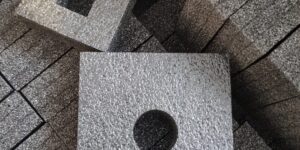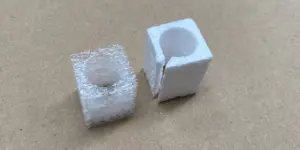


A client in the dietary supplements sector approached us with a request to optimise the packaging process for small glass bottles. The polystyrene inserts used previously ensured product stability, but did not fully meet the growing requirements regarding operational efficiency and packaging aesthetics. In response, we designed PE foam inserts tailored to the specific product and packaging format.
Zamiana kształtek styropianowych (EPS) na kształtki z pianki PE pozwoliła poprawić estetykę, ograniczyć pylenie i usprawnić pakowanie szklanych flakonów bez zwiększania kosztu całkowitego procesu.
Starting point
A client manufacturing supplements had been packaging small glass vials using polystyrene (EPS) moulded parts. The solution had been in use for some time, but over the months problems began to arise that affected both the packaging process and the end customers’ perception of the product.
The most commonly reported difficulties included:
- styrofoam dust and crumbs in the box,
- the package looks unattractive when unpacked,
- losses were already occurring at the packing stage, as the polystyrene fittings crumbled under heavy use.
These issues not only compromised the quality of the logistics process, but also affected the overall perception of the product. It is also worth noting the environmental aspect. Although EPS polystyrene is a theoretically recyclable material, in practice it often ends up in mixed waste. This limited the actual potential for recycling the moulded parts and affected the environmental assessment of the packaging as a whole.
Our activities
In the first stage, we focused on analysing the packaging process: how the bottles are arranged, warehouse operations, and how the product fares during transport.
We then proposed PE foam inserts, tailored to fit both the dimensions of the bottle and the cardboard box in which the product was shipped.
The project took into account:
- precise slots for each bottle,
- precise tolerances achieved through CNC milling, which eliminates play and product ‘drift’,
- the closed-cell structure of the foam, which provides shock absorption,
- a material that is safe for use with supplements and delicate glassware.
By tailoring the moulded part to the specific product, it was possible to maintain the stabilising function without increasing the weight of the parcel or altering the volume of the packaging, whilst also achieving greater material flexibility.
The solution implemented
EPS polystyrene mouldings have been replaced by smooth PE foam mouldings, which:
- they fit the shape of the bottle perfectly,
- they do not produce dust or crumble during use,
- are safe for glass and delicate surfaces,
- enable faster and more consistent packaging, as the moulded parts are easier to handle.
An additional advantage was the ability to fully integrate the moulded part with the cardboard box – the two elements formed a single, cohesive packaging unit.
Results following implementation
Within the first few weeks of switching materials, the customer noticed clear benefits:
- better stability of bottles during transport,
- a cleaner and more organised packaging process,
- faster warehouse operations thanks to intuitive product placement and the ability to ‘squeeze’ fittings without the risk of damaging them,
- a better impression for the end customer when unpacking.
Importantly, the optimisation did not require a technological revolution or investment in new materials – simply changing the packaging format proved sufficient.
Summary
This case study demonstrates that PE foam moulded parts are not merely a protective element for the product, but a tool for optimising the entire logistics process.
Thanks to their precise fit, the material’s flexibility and the ability to design them specifically for a particular product, the packaging ceases to be a mere accessory and becomes an integral part of the product and the customer experience.
We can help you and optimize the packaging process in your company
Make an appointment with our advisor


A marketing manager and content enthusiast passionate about creating materials that bring real value to the audience. She explores the world of packaging through the lens of actual customer challenges, drawing insights from conversations with business owners, buyers, and warehouse staff alike. Outside of work, she’s a fan of non-fiction books and gravel biking.