

PPWR is the EU Packaging and Packaging Waste Regulation – Regulation (EU) 2025/40. This distinction is important because it is a regulation, not a directive, meaning its provisions apply directly across EU Member States and are intended to create more harmonised rules for the entire market. PPWR entered into force on 11 February 2025 and will generally apply from 12 August 2026.
The regulation covers the entire packaging lifecycle — including packaging design, material composition, use, labelling, reusability, recyclability, and packaging waste management.
PPWR objectives
The objective of PPWR is not only to reduce waste, but also to transform the way the packaging market operates. The regulation is intended to ensure that packaging becomes lighter, easier to recycle, more frequently based on recycled materials, and — where justified — reusable. The European Commission highlights four main directions:
- recyclability of all packaging by 2030,
- increased recycled content in plastic packaging,
- reduction of unnecessary packaging,
- development of reuse/refill models.
RecyClass – recyclability classes
The most significant qualitative innovation is the introduction of recyclability performance grades from A to C. According to current analyses, from 2030 onwards, only packaging classified within these three highest categories will be allowed on the market.
The recyclability grade will depend on material composition, packaging design, ease of component separation, and the availability of sorting and recycling infrastructure. Packaging classified as grade D or lower will effectively be phased out from the market, primarily affecting complex multi-material laminates (e.g. PET/PE/AL) that are difficult to separate and recycle.
6 key areas of change introduced by PPWR
- First – packaging design
- Second – reducing excessive packaging
- Third – raw materials and recycled content
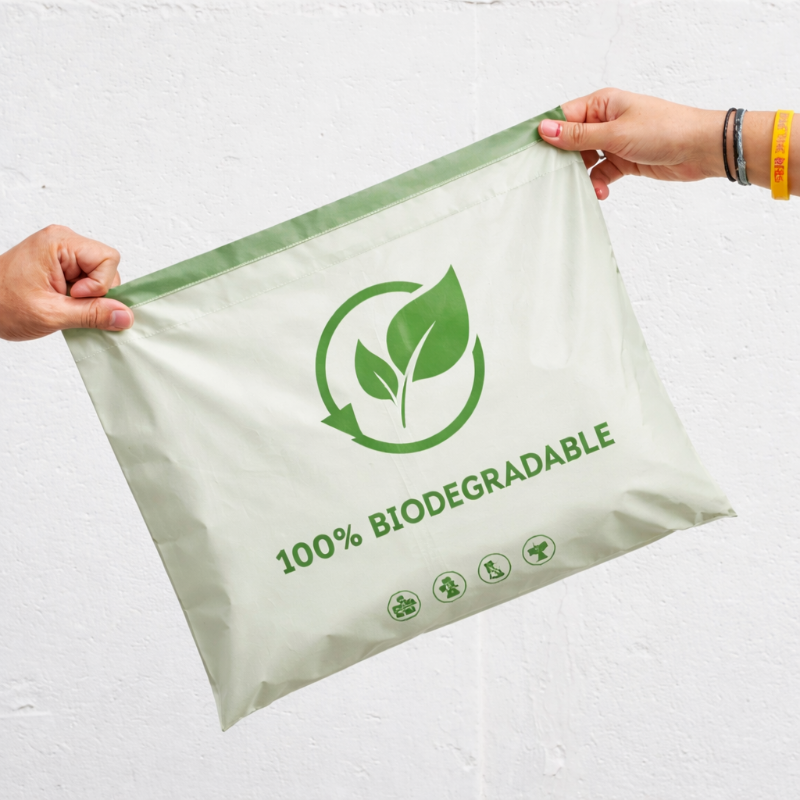
For plastic packaging, PPWR introduces minimum recycled content requirements for 2030 and 2040, with target levels depending on the packaging category. The Council of the European Union indicates that for certain categories — such as single-use plastic bottles — recycled content targets may increase to as much as 65% by 2040.
This will require changes in procurement policies, supplier qualification processes, and the documentation of raw material origin.
| Plastic packaging category | Minimum PCR content (2030) | Minimum PCR content (2040) |
|---|---|---|
| Contact-sensitive packaging (PET, e.g. bottles) | 30% | 50% |
| Contact-sensitive packaging (other than PET) | 10% | 25% |
| Single-use plastic beverage bottles | 30% | 65% |
| Other packaging (films, foams, stretch film) | 35% | 65% |
- Fourth – labelling and information
- Fifth – chemical safety of packaging
- Sixth – financial responsibility and extended producer responsibility (EPR)
How the upcoming waves of change will unfold and what they require from businesses
- Wave 1: preparation and compliance audit — now / until 12 August 2026
- Wave 2: start of PPWR application — from 12 August 2026
- Wave 3: labelling and information standardisation — 2028–2029
- Wave 4: major operational transformation — 2030
- All packaging must comply with “Design for Recycling” criteria within recyclability classes A, B, or C.
- A maximum empty space ratio of 50% applies in e-commerce and logistics packaging.
- The first minimum PCR content thresholds come into force (e.g. 35% for PE films and foams).
- A ban is introduced on selected single-use plastic packaging formats, including grouped packaging for bottles (shrink film), miniature hotel cosmetics, and packaging for fruit and vegetables below 1.5 kg.
- HORECA businesses offering takeaway meals must allow customers to use their own containers.
- Wave 5: proving that packaging works within a real recycling system — 2035
- Wave 6: further tightening of requirements — 2040
Year 2026 – start of application and first restrictions
12 August 2026 marks the general application date of the PPWR regulation. From this day onwards, restrictions on the use of “forever chemicals” (PFAS) in food-contact packaging will apply whenever permitted limits are exceeded.
Year 2027 – changes in the HoReCa sector
By 12 February 2027, food service businesses offering takeaway food or beverages will be required to allow consumers to bring their own containers for filling (under conditions no less favourable than when using single-use packaging).
Year 2028 – labelling and compostability
From 12 February 2028, permeable tea/coffee bags and adhesive labels applied directly to fresh fruit and vegetables will be required to be compostable.
From 12 August 2028 (or 24 months after the adoption of implementing acts), harmonised sorting labels will become mandatory across the European Union for packaging (excluding transport packaging). Visually identical labels will also have to appear on waste collection bins to facilitate proper waste separation by consumers.
Year 2029 – deposit return systems and reusable packaging
From 1 January 2029, Member States must ensure the operation of mandatory Deposit Return Systems (DRS) for single-use plastic beverage bottles and metal beverage cans (up to 3 litres) in order to achieve a 90% separate collection rate.
From 12 February 2029 (or 30 months after the adoption of implementing acts), reusable packaging will be required to carry a dedicated label and QR code (or another data carrier) enabling tracking and calculation of packaging rotation cycles.
Year 2030 – a revolution in the packaging market
This is the year when most of the key requirements for businesses come into force:
Recyclability: All packaging placed on the market must comply with strict EU Design for Recycling criteria.
Mandatory recycled content in plastics: Every plastic packaging component will be required to contain specified minimum levels of recycled materials (e.g. 30% for PET bottles, 10% for other food-contact packaging, 35% for remaining plastic packaging).
Bans on selected single-use formats (Annex V): The market will phase out, among others, single-use shrink film for grouped packaging (multipacks), single-use packaging for fresh fruit and vegetables below 1.5 kg, miniature hotel cosmetics, and single-use condiment and sauce packaging in gastronomy.
Minimisation and empty space: Full enforcement of packaging weight and volume minimisation rules will apply, including the strict maximum 50% empty space limit in e-commerce shipments and transport packaging.
Reuse targets: Businesses will need to ensure that a specified share of transport, grouped, and beverage packaging consists of reusable solutions. The HoReCa sector must also work towards offering 10% of takeaway products in reusable packaging.
Waste reduction: By 2030, Member States will be required to reduce packaging waste generated per capita by 5% compared to 2018 levels.
Years 2035 and 2040 – further tightening of requirements
2035: The recyclability requirement will be expanded to include assessment of whether packaging is “recycled at scale”. Member States will also need to achieve a 10% reduction in packaging waste.
2040: Required recycled content levels in plastic packaging will increase significantly (e.g. up to 65% for beverage bottles). Target reuse rates for transport and beverage distribution packaging will also rise, while the packaging waste reduction target will increase to 15% per capita.
| Regulatory parameter | Description and timeline in accordance with PPWR (EU) 2025/40 |
|---|---|
| Entry into force | 11 February 2025 |
| General application date | 12 August 2026 (18 months after entry into force) |
| Mandatory recycling targets (general) | 65% by the end of 2025; 70% by the end of 2030 |
| Restriction on PFAS in food packaging | From 12 August 2026 |
| Full recyclability of all packaging | From 1 January 2030 |
| Minimum PCR recycled content in plastics | From 30%–35% in 2030; up to 65% in 2040 |
The day-to-day impact of PPWR on European companies
- In procurement, companies will face the need for stricter qualification of suppliers and materials, including material composition declarations, recycled content information, food-contact compliance, PFAS confirmations, and data required for labelling.
- In R&D and technology departments, companies will need to test new packaging designs, reduce material complexity, and compare different variants in terms of recyclability as well as weight and volume minimisation.
- In logistics and warehousing, greater importance will be placed on selecting the right packaging size, reducing empty space, standardising formats, and — in certain segments — transitioning to reusable packaging models.
- In sales and marketing, companies will need to adopt more careful environmental communication, update labels and product materials, and better explain to customers why specific packaging solutions are changing.
- In finance, companies will need to consider not only the packaging purchase cost, but also future compliance costs, regulatory fees, artwork updates, testing, implementation expenses, and the risk of withdrawing non-compliant solutions from the market. This is particularly important in Poland, where the Extended Producer Responsibility (EPR) system is also expected to undergo significant changes.
Summary
| EPR system element | Impact mechanism on businesses under PPWR |
|---|---|
| Eco-modulation of fees | Fees dependent on recyclability class (A < B < C) |
| Administrative penalties | Up to PLN 2,000,000 for placing non-compliant packaging on the market |
| Market withdrawal | Obligation to withdraw products at the company’s expense in the absence of required documentation |
| Marketplace control | E-commerce platforms will be required to verify sellers’ EPR status |
Frequently Asked Questions (FAQ)
The PPWR Regulation entered into force on 11 February 2025, which was the twentieth day following its publication in the Official Journal of the European Union.
However, it is important to distinguish between the regulation entering into force and the date when its provisions start to apply. The general application date of the regulation is 12 August 2026.
PPWR includes a number of transitional periods, meaning that specific obligations will apply at different, later dates. The most important milestones include:
• 12 August 2026 – from this date, among others, restrictions on PFAS in food-contact packaging will begin to apply.
• 12 February 2029 – application date of the provision specified in Article 67(5).
• 1 January 2030 – from this year onwards, most key regulations will apply, including: recyclability requirements for all packaging placed on the market, mandatory recycled content targets for plastic packaging, bans on selected single-use packaging formats, the strict 50% empty space limit in e-commerce and transport packaging, and reuse targets.
As PPWR is an EU regulation, it is fully binding and directly applicable in every Member State (including Poland). This means that its provisions do not require transposition into national law, but apply directly within the specified timelines.
In simple terms, the regulation applies to every participant in the supply chain that interacts with packaging in any way — whether by designing, manufacturing, distributing, packing, or placing it on the market.
According to the official definition of an economic operator under PPWR, the obligations imposed by the regulation apply to the following groups:
- Manufacturers (e.g. producers of empty packaging or companies packing products under their own brand)
- Suppliers (providing packaging materials or finished packaging to manufacturers)
- Importers (placing packaging or packaged goods from non-EU countries on the EU market)
- Distributors (all entities in the supply chain making packaging available on the market)
- Final distributors (e.g. retail stores, restaurants, hotels — the HoReCa sector — supplying products directly to end users)
- Fulfilment service providers (e-commerce or logistics companies responsible for warehousing, packing, addressing, and shipping products on behalf of other entities)
- Authorised representatives (entities designated to fulfil obligations, for example on behalf of companies outside the EU)
Importantly, at every stage of the supply chain, each entity must ensure that its activities (e.g. transport or repacking) do not negatively affect whether the packaging complies with the regulation’s requirements, such as recyclability criteria.
PPWR (short for Packaging and Packaging Waste Regulation) is the EU regulation on packaging and packaging waste (formally: Regulation (EU) 2025/40 of the European Parliament and of the Council). It replaces the previous Directive 94/62/EC.
As an EU regulation, PPWR applies directly in all Member States and does not require transposition into national law, which represents a significant change compared to previous directives.
The regulation is primarily intended to:
- Harmonise packaging regulations across the entire EU internal market, helping to prevent trade barriers and simplify business operations.
- Reduce the negative environmental and health impact of packaging and packaging waste throughout their entire lifecycle.
- Accelerate the transition towards a circular economy and support the achievement of climate neutrality goals.
The PPWR Regulation has a very broad scope and covers all packaging placed on the EU market, as well as all packaging waste generated, regardless of the material used. This applies to both empty and filled packaging, including packaging manufactured within the EU and imported from third countries.
The regulation covers packaging regardless of its intended use, including:
- Consumer (B2C) and business/industrial (B2B) packaging – used in households, retail, services, offices, distribution, and industry. This includes all packaging levels: sales (primary) packaging, grouped packaging, transport packaging, and e-commerce packaging.
- Service and single-use packaging – products designed to be filled at the point of sale, such as paper or plastic shopping bags, disposable cups and plates, food wrap, or sandwich bags.
- Packaging components and auxiliary elements – elements attached to products or performing a packaging function, such as self-adhesive labels, mascara brushes forming part of the closure, detergent measuring caps, staples, or plastic sleeves.
- Tea and coffee bags and capsules – a new element compared to some previous regulations. PPWR explicitly defines permeable tea or coffee brewing bags, as well as impermeable single-serve capsules intended for coffee machines, as packaging.
- Flower and plant pots – but only those intended for the transport and sale of plants (production pots in which plants are grown are not considered packaging).
A marketing manager and content enthusiast passionate about creating materials that bring real value to the audience. She explores the world of packaging through the lens of actual customer challenges, drawing insights from conversations with business owners, buyers, and warehouse staff alike. Outside of work, she’s a fan of non-fiction books and gravel biking.