

The dynamic development of the e-commerce sector over the last decade has radically changed the operational cost structure of commercial enterprises. While a decade ago the main challenge was stock availability, today the competitive struggle has moved to the field of last-mile logistics and distribution centre efficiency. In 2024, the global e-commerce packaging market was valued at $77.4 billion, with a projected increase to nearly $125 billion by 2029, implying a compound annual growth rate (CAGR) of 10%. However, this rapid growth in order volume is colliding with supply barriers in the labour market and rising operational costs.
Order fulfillment cost structure
Data from the American and Western European markets indicate that the average order fulfillment cost is approximately $8.50. In this structure, packaging material costs typically account for 10% to 20% of the total amount, while labor, warehousing, and shipping costs dominate.
The problem logistics managers face is the disparity between the fixed cost of materials and the rising cost of human labor. In Western Europe, which often serves as a benchmark for efficiency standards, hourly rates for warehouse workers are trending upward. In Germany, the average salary for a warehouse worker ranges between EUR 14–18 per hour, and for skilled forklift operators, these rates are even higher. In the Netherlands, rates hover around EUR 14–18, while in Denmark they reach levels as high as DKK 180 (approx. EUR 24) per hour. In the United States, the “fully loaded” labor cost (including taxes and benefits) for a warehouse worker is often a multiplier of 1.35-1.42 of the hourly rate, which translates to a real cost for the employer of USD 27-28 per hour.
In such an economic environment, every second saved in a manual process carries a measurable financial value. The traditional approach of minimizing the purchasing costs of packaging materials (e.g., buying the cheapest roll of film) becomes an economic trap if the inexpensive material requires a longer application time. As experts from F. Curtis Barry & Company point out, precisely tracking the “cost per order” metric allows for the identification of bottlenecks, while rising labor costs force a search for solutions that increase throughput without increasing headcount.
Bottleneck at the packing station
Material flow analysis in a typical e-commerce warehouse shows that the packing zone is the most frequent location for bottlenecks, especially during peak periods (Black Friday, Cyber Monday, the pre-Christmas period, seasonal sales). While the picking process is increasingly supported by automation and path optimization, packing in many companies remains a manual process, dependent on the dexterity and commitment of the employee.

Research indicates that the average “packer” is able to pack approximately 15–20 complex orders per hour using traditional methods. Increasing this rate is possible in two ways—through full automation, which involves significant costs, or through manual optimization, which is accessible to companies of all sizes. It is in this second area that switching the protective medium from rolls to bubble wrap bags plays a key role.
Time & motion analysis – the scientific basis for savings
The basis for the thesis of a 30 percent reduction in packaging time is the Time & Motion Study methodology, pioneered by scientific management trailblazers Frank and Lillian Gilbreth. This analysis involves breaking down an employee’s activities into basic motion units—such as searching, grasping, moving, positioning, and assembling—and then eliminating redundant and inefficient movements.
Traditional vs. modern packaging
To understand the origin of these savings, it is necessary to conduct a process analysis of packaging a product (e.g., delicate electronics or ceramics) using two competing methods: traditional bubble wrap in a roll and a bubble wrap bag.
Scenario A - traditional packaging (bubble wrap roll)
This process is characterized by high kinetic and decisional complexity. The employee must perform the following sequence of motions:
- Product retrieval - grasping the item from the buffer zone.
- Decision and measurement - evaluating the size of the item and estimating how much film from the roll will be needed. This is a decision-making moment that generates cognitive micro-pauses and often leads to overpackaging (the employee takes more material than is necessary).
- Roll manipulation - unrolling the film from a large roll (often suspended over the table or standing next to it).
- Initial wrapping - wrapping the item with the first layer, often requiring rotating the product in the air or on the table.
- Cutting - reaching for a cutting tool (knife or scissors) and cutting the film. This is a "dangerous" task that requires precision.
- Final wrapping - completing the wrapping, forming the package.
- Taping - putting down the cutting tool, reaching for the tape dispenser (or a pre-cut piece of tape), locating the edge of the film, and sealing the package, often in two planes to prevent the film from sliding off.
- Placing in outer packaging - placing the wrapped product into the shipping carton.
Analysis classifies many of these movements as “inefficient.” Reaching for tools (scissors, tape), putting them back, or rotating the product constitutes a waste of time and energy. Furthermore, this process is prone to errors—the film may unroll before it is taped, forcing the task to be repeated.
Scenario B - optimized packaging (bubble wrap bag)
The use of a bubble wrap bag, especially in the version with a self-adhesive strip, radically simplifies this scheme by reducing the number of motions:
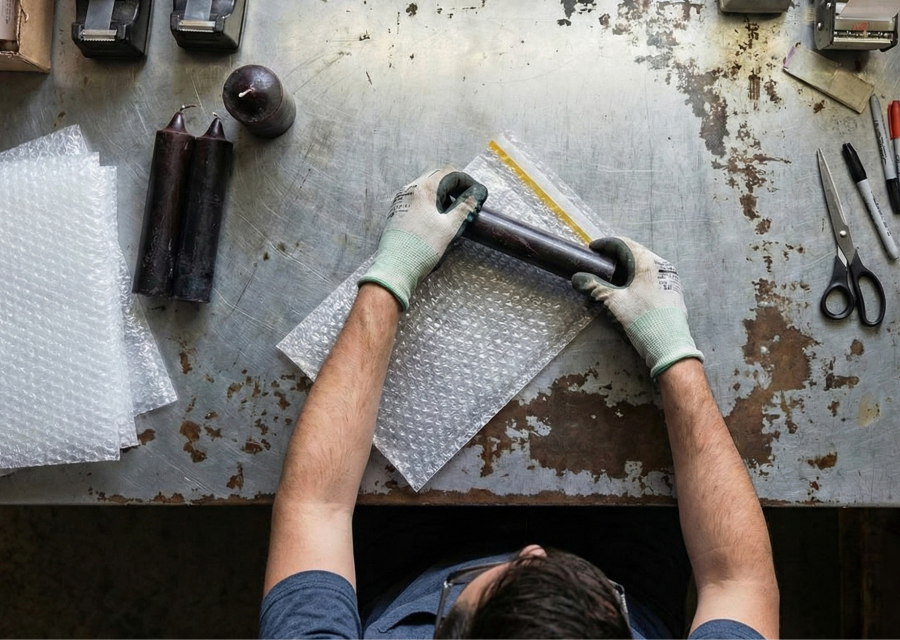
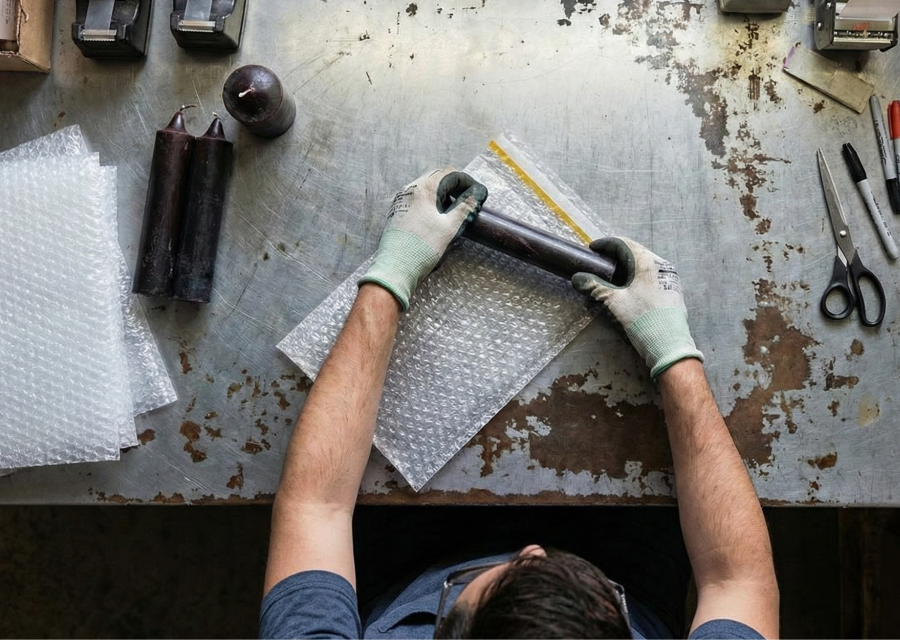
- Product and bag retrieval - simultaneous or sequential grasping of the product and the appropriate bag (taken from a bulk box with a single, straight motion).
- Insertion - sliding the product into the bag. Because the air bubbles are on the outside (in most designs) or on the inside with a slip layer, the product enters smoothly.
- Closing - peeling off the adhesive protection strip (with a single thumb motion) and folding the flap.
- Placing in outer packaging - placing the finished package into a carton or a poly mailer.
Eliminating the stages of cutting, shaping the form, and taping visibly shortens the process time. The bubble bag is a “one-motion” solution (one smooth movement), in contrast to the multi-stage wrapping operation.
Numbers illustrating the importance of the change
The average worker is able to pack approximately 30–50 standard boxes per hour using traditional filling and wrapping methods. When using bubble mailers or protective bags, this number increases to 60–90 units per hour. This represents a potential productivity increase of up to 80–100%, which significantly exceeds the conservative assumption of 30% in the title of this study.
The use of bags with an adhesive strip completely eliminates the time spent operating packaging tape. In a standard cycle, “taping” takes from 5 to 15 seconds per package (finding the end of the tape, unrolling, sticking, cutting). On a scale of a thousand packages a day, this results in savings of about 4 working hours per day per workstation.
Reduction in movements means better work ergonomics
The mentioned change in packaging methods is not only about time, but also about effort. Traditional wrapping with film from a roll requires a high number of movements in the wrist and elbow joints, as well as constant muscle tension when cutting the film and tape. This leads to faster worker fatigue during a shift, which in turn results in a drop in productivity during the final hours of work.
The introduction of bubble bags significantly improves ergonomics. The motions are simpler, require less force, and are more natural. Less fatigue means maintaining a steady work pace throughout the entire 8-hour shift.
TCO analysis as the basis for a packaging system decision
A common counterargument against the implementation of bubble bags is their higher unit cost compared to a linear meter of film from a roll. However, this is a classic cognitive bias, consisting of comparing the purchase price instead of the Total Cost of Ownership (TCO).
In developed countries, the cost of human labor outweighs the cost of consumables in the packaging process. If a worker earns (employer cost) 20 EUR per hour (approx. 0.33 EUR per minute) and packing a parcel using the traditional method takes 2 minutes, the labor cost is 0.66 EUR. If using a bubble bag reduces this time to 1 minute, the labor cost drops to 0.33 EUR. Even if the bag is 0.10 EUR more expensive than a piece of film, the company generates a net profit of 0.23 EUR on every package. At a volume of 10,000 packages per month, this results in savings of 2,300 EUR, not including the profits from the ability to handle more orders with the same team.
Standardization of the amount of materials retrieved – elimination of the overpackaging problem
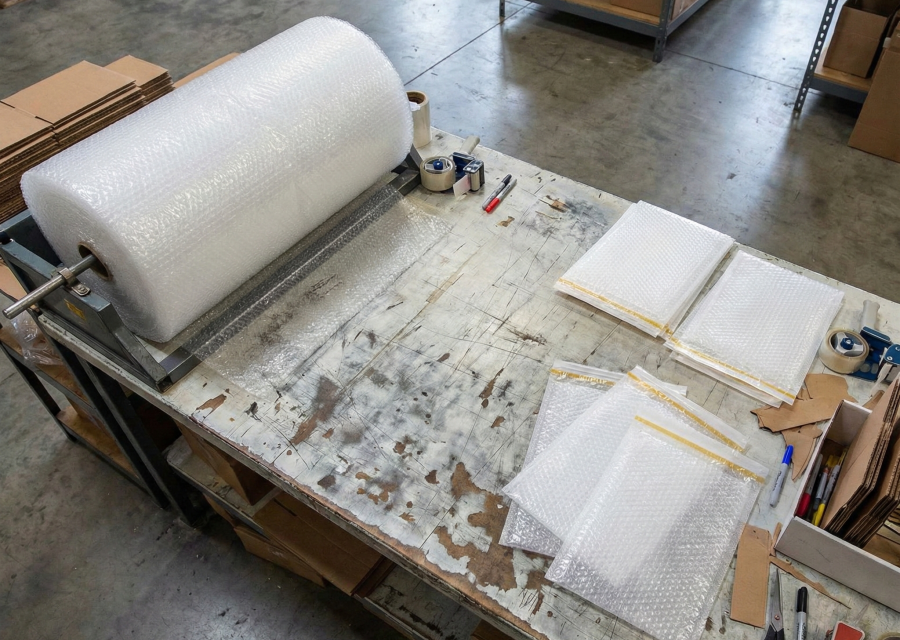
The phenomenon of “overpackaging” (excessive packaging) is a plague in manual processes. Employees, wanting to secure the goods well “just to be safe,” tend to wrap them several times with film from a roll. This leads to uncontrolled material consumption.
The problem is the lack of a standard. One employee uses 0.5 m of film, another 1.5 m for the same product. The solution? A bubble bag, which enforces binary standardization – the product is either in the bag or it is not. Material consumption is constant, predictable, and accurately correlated with the number of orders (1 order = 1 bag). This allows for precise budgeting and price negotiations in bulk purchases, leveraging economies of scale.
Dimensional weight optimization
Modern courier logistics is increasingly based on dimensional weight. Carriers charge fees for the space a package occupies in the vehicle, and not just for its physical weight.
Traditional wrapping with film creates irregular shapes, which often force the use of larger cardboard boxes and fillers such as air pillows or packing peanuts. These additional elements increase the volume of the package.
Bubble wrap bags, thanks to their flat construction and fit to the product, allow for the use of smaller outer packaging (e.g., poly mailers instead of boxes).
Warehouse space savings
Bubble wrap rolls are a volumetric commodity. Storing hundreds of rolls takes up valuable space on pallets and racks. Bubble bags are delivered in compressed bulk cartons, taking up significantly less space for the same number of packaging units. In a warehouse environment, where the cost per square meter is constantly rising, this is another hidden operational saving.
Packaging aesthetics and brand building
In e-commerce, packaging is often the only physical contact the customer has with the brand. The aesthetics of how the goods are secured have a direct impact on the perception of product value and consumer loyalty.
A product irregularly wrapped in a clump of film and taped in a “crosswise” fashion looks messy and cheap. This can suggest to the customer that the company does not care about quality. A bubble bag offers a clean, professional appearance. The edges are even, the closure is aesthetic, and the whole thing looks like a well-thought-out part of the product, rather than just transport waste.
Łatwość rozpakowywania (unboxing)
For the end customer, fighting a “mummy” made of bubble wrap and adhesive tape is frustrating and creates a risk of damaging the product with scissors during opening. A bag with an adhesive strip or a string closure (zip-lock) opens easily and intuitively. What is more, variants with a zip-lock closure allow the customer to reuse the bag, which builds positive brand associations in the spirit of zero waste.
Ecological aspects
In an era of growing environmental awareness and EU regulations regarding packaging waste (PPWR – Packaging and Packaging Waste Regulation), the choice of materials is of strategic importance. Although bubble wrap is a plastic (LDPE), its form as a bag can be more ecological than alternatives. Additionally, if a manufacturer like Mac-Graf uses regranulate to produce the bags and operates in a circular economy, and the bag itself is 100% recyclable, it turns out that bags gain another important argument that goes strictly beyond unit purchase costs.
How to switch from bubble wrap rolls to bags?
For Mac-Graf customers, transforming the packaging process does not have to be a revolution, but an evolution. The table below presents the recommended implementation path based on market best practices.
| Implementation stage | Operational actions | Goal |
|---|---|---|
| 1. Assortment audit | ABC/Pareto analysis of shipped products. Identification of product groups with repeatable dimensions (e.g., cosmetics, phones, books). | Identification of the 20% of products generating 80% of the packaging volume. |
| 2. Selection of sizes | Ordering samples of bags tailored to the identified product groups. Consultation with the supplier to optimize film weight. | Elimination of "air" in the package. |
| 3. Workstation reorganization | Removal of rolls and knives from packing tables for selected processes. Installation of bag organizers within the worker's reach. | Improvement of ergonomics and occupational safety. |
| 4. Personnel training | Short instruction on the "Slide and Seal" method. Demonstrating the difference in packing time. | Changing habits and acceptance of the new standard. |
| 5. KPI Monitoring | Measurement of packing time before and after implementation. Analysis of material consumption after one month. | Verification of savings and potential correction of bag sizes. |
Do you want to test how bubble wrap bags will work for your business? Leave your contact details, and our advisor will get in touch with you to suggest where it is worth starting in your situation.
We can help you and optimize the packaging process in your company
Make an appointment with our advisor


A marketing manager and content enthusiast passionate about creating materials that bring real value to the audience. She explores the world of packaging through the lens of actual customer challenges, drawing insights from conversations with business owners, buyers, and warehouse staff alike. Outside of work, she’s a fan of non-fiction books and gravel biking.